Showing posts with label prosperity. Show all posts

Wednesday, February 1, 2012

Catherine Ponder and the Rich Jesus

I am still working on my The Secret chapter -  it is the final chapter and seems as though it will never end.
One of the authors that Rhonda Byrne urges people to read is Catherine Ponder, who, she says, teaches the truth of the Bible stories - that Jesus, the prophets and patriarchs were in fact wealthy people who despised poverty.
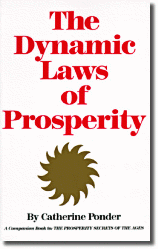


When I worked in a New Age bookshop in Sydney in the 90s and 2000s Ponder's books were very popular, despite their high price. Published by DeVorss publications, Catherine Ponder is a Unity minister (ordained in 1956) who wrote quite a number of books, all based around her particular reading of the Bible as a prosperity text. After her endorsement in The Secret, it seems as though her books have reached a whole new generation of readership, and I notice that the Rev. Dr. Barbara King, one of my favourite women in the world, is teaching at the moment a course based on Ponder's books at her New Thought-based Hillside Chapel in Atlanta, Georgia.
I have gone back to look at Catherine Ponder's book The Dynamic Laws of Prosperity - a substantial text at 430pp. Ponder's style is folksy and engaging, and highly reminiscent of the earlier books of Florence Scovel Shinn. The book is filled with miraculous stories of people who have applied the techniques of New Thought in  their lives and achieved marvellous and unexpected results, usually in the shape of improved finances, work opportunities and greater prosperity. Ponder urges her readers to re-awaken to older dreams of greatness, happiness and wealth, and to employ the usual New Thought technologies of visualisation and affirmation to progress towards greatness. 
I'm not sure that Ponder needed to write quite as many books on the same theme as she did - the central message is repeated ad infinitum - but I have no doubt that she was sincere in her beliefs and her passion and enthusiasm is patent in her writing style. Hers was a thoroughly New Thought vision of the possibility of all people to be great, to be rich and happy and ultimately useful. There is, as well, something of the old-fashioned self-help notion of thrift and financial indepenedence, not to mention self-responsibility. The Ponderian subject is financially independent, working hard to enjoy good and beautiful things and to help others who may be less fortunate.
Ponder sees the individual as the primary source of their own poverty. The natural state is one of wealth, and if we would only stand aside we would allow the Universe to assert its own inevitable prosperity in our lives once again. She writes:

"In order to become financially independent, to the extent of having a constant financial income, it is necessary to discard a number of negative attitudes."


For Ponder, the first step towards wealth is the reorganisation of the mind, filling it with images of the  things we want and of the limitless possibilities before us. No wonder she is endorsed so heartily in The Secret.


  • For more information about Florence Scovel Shinn, one of Ponder's principle influences, look here
  • To read more about Catherine Ponder on her publisher's website, look here
  • An interview with Rhonda Byrne, creator of The Secret


Friday, October 14, 2011

October 14: Reading Notes

This week I've been working on my chapter on the literature of sales, management and prosperity, and if I say so myself it is shaping up to be an interesting section. I have decided to explore 5 main themes in the chapter (this is usually the way I do it, though one or other of the themes normally fades away from lack of interest): Playing the Game of Life; Being Valued; The Book as Agent of Improvement; Controlling Our Reality; and The Moment of Success.


The main author I am using in this chapter is Paul Hanna. He is an absolutely intriguing figure, and I once attended a conference where he spoke, so I feel I have more of a handle on his whole technique. I will be drawing principally from his books You Can Do It, Don't Give Up and The Sales Motivator.

Another author I am using is the flamboyant advertising man Siimon Reynolds, especially his books Become Happy in Eight Minutes and Why People Fail.


The last person I am examining at any length is Sydney real-estate tycoon John McGrath and his book You Inc. Again, I have seen him in action at a conference, and his style is nothing like Paul Hanna's - he is quiet and shy and does a whole understated act.

I suppose that people imagine such books would be terrible, but in fact they are very effectively written, filled with quotes and case-studies and lots and lots of motivating exhortation. All of the above writers are actually quite good at what they do, and I would suggest deserve more respect than they will probably ever get from the literary establishment.


The central book I am comparing them all to, and the book they themselves cite frequently, is Napoleon Hill's classic Think and Grow Rich.


Tuesday, October 6, 2009

Prosperity Spirituality


One of the most popular forms of New Thought thinking, and one of the most controversial, is that of Prosperity Spirituality. The idea that cultivating a spiritual life can lead to material riches has always been a fundamental part of New Thought philosophy, and is what sets New Thought apart from standard Christian theology more than anything else.
The Prosperity Spirituality probably reached its apotheosis in the books of Catherine Ponder. Books like The Millionaire from Nazareth set out a new vision of Christianity that rejects the glorification of poverty and instead urges the reader to "give your attention to the science of acquiring wealth."
As much as the religious mainstream likes to make fun of these ideas, there is no denying that they are enormously attractive to the average reader/churchgoer, as is evidenced by the continued popularity of material espousing a Prosperity Spirituality. Certainly The Secret is a part of this tradition, containing as it does quote after quote from more contemporary writers and speakers advocating the power of thought to create good material circumstances.
True to her training in the New Thought tradition, Louise Hay has also always advocated the cultivation of prosperity, and defines prosperity according to health, happiness and spiritual contentment, along with the possession of objects. This is, of course, always the ultimate answer to those who might challenge the morality of Prosperity Spirituality - the greatest evidence of prosperity is a warmth and generosity of spirit, and who would seek to begrudge these?
The implication of the Prosperity Spirituality books seems to be that if we seek to be more spiritual and cultivate a truly spiritual existence, then prosperity can never be far behind. It is merely the outcome of correct living and positive states of mind. For in being spiritual, we simply release, as Catherine Ponder says, "the Divinity that is within you which is never poor."

Friday, April 3, 2009

Catherine Ponder


Catherine Ponder is one of the most stellar, and certainly one of the most loveable, figures in the history of self-help publishing.
Ms. Ponder rose to fame through a series of books which managed, somewhat perplexingly, to fuse Biblical stories with a self-help theory of prosperity and personal development. Currently I'm reading her great classic The Dynamic Laws of Prosperity. Some of her other titles include The Millionaires of Genesis and The Millionaire Moses.
Ponder's own biography is an essential part of her appeal. Born poor, she was widowed at an early age and left destitute. Through a careful study of the Bible and the writings of Charles & Myrtle Fillmore, Ponder managed to create for herself a prosperous lifestyle. She became a Unity minister, and went on to Pastor several successful congregations, teaching her own high-octane version of the prosperity gospel and running workshops on spirituality and the creation of money.
These workshops and lectures make up the bulk of the material in her books, and have also been the source of many of the examples and case studies she cites.
The books are wonderfully eccentric, veering from old-fashioned biblical exegesis to frenzied affirmations of impending wealth and well-being. She peppers the books with all kinds of eccentric advice and exercises, from throwing away all of one's old clothes in order to allow the universe to send you nice new ones, to writing letters to one's angels and secreting them in the family bible till your wishes come true.
As one would expect from a Unity minister, Ms. Ponder's philososphy is pretty standard New Thought, but her wildly successful books prove that her readership extends well beyond that particular religion.
I just adore her - I imagine she was/is a completely outrageous and very colourful person, and the assuredness of her assertions and randomness of her advice make the books constantly entertaining, and frequently inspiring.