Monday, July 12, 2010
The Eternal Mind in The Science of Mind
Ernest Holmes' own specialised terminology flows thick and fast throughout his mammoth text The Science of Mind. I suspect that at times terms are interchangeable, but I may be wrong - he may be completely thorough and consistent in his subtle use of terminology. I would have to read the book many times over to be able to ascertain that, and to be honest I don't think that's going to happen.
There are many terms for God, and they are quickly identified by the capitalisation of the first letter. One of the most common is Mind, occasionally more clearly signified as Eternal Mind. This Eternal Mind is the creative, unifying force at work in the universe, the thing to which we are all attached, and from which we all emerged. It is separate from the small-m mind that we all possess, but only because we have limited our material minds, and enforced our own separation. In fact, the goal of Science of Mind (i.e. Holmes' philosophy) is to re-unify us with the Eternal Mind, so that we can experience one-ness with the absolute.
Holmes tells us that "the Eternal Mind knows all things" and this assures the reader that what we are talking about here is the old-fashioned God, re-cast as something more scientific, less loaded. It is subtle theology, and I imagine quite effective - few could quarrel with the notion of the mind, something we all possess.
These two minds - the material and the Eternal - are the essence of Science of Mind philosophy. What the spiritual practitioner is doing is training the small mind (Holmes says "renewing") to work in accord with the Eternal Mind, so that we might recognise our own divinity. This is an individual project, and the work can only ever be done by the individual - we cannot hope to change the mind of another.
By turning our thoughts toward good, the mind is retrained, and material circumstances are changed. In Holmes' philosophy (as in the Fillmores' and Mary Baker Eddy's) good must always trump evil - a good thought held in the mind will drive out all evil, for only good is real. Good is of the Eternal Mind - it is its essential nature.
Labels:
Ernest Holmes,
Eternal Mind,
mind,
New Thought,
science of mind,
Universal Mind
Tuesday, June 8, 2010
The New Testament in The Science of Mind
The Fifth part of Ernest Holmes' The Science of Mind is taken up with a more in-depth exploration of the New Testament, dwelling particularly on the healing stories of Jesus. Citing chapter and verse, Holmes attempts a metaphysical explanation of these familar stories, stressing the ways in which they might show us that the healing powers of God are available to us all. Because Christ consistently healed the pathetic, the outcast and the seemingly unworthy, Holmes sees this as evidence that the Love if God is complete and all-encompassing - no-one is unworthy in the eyes of the Divine.
He says adamantly that "God knows no evil" (p. 438), and this kind of rhetoric is directly traceable to his teacher Emma Curtis Hopkins, who herself learned it from Mary Baker Eddy. Holmes says that Jesus was teaching this reality as he healed - by pointing out that people themselves laboured under the delusions of sin, sickness and unforgiveness. Jesus freed them from these self-imposed states of misery by making them realise that in God's eyes they were entirely perfect.
He reads Matthew 9:16 as an injunction to abandon old spiritual ideas. For Holmes the new is invariably the right, because the human is forever on an evolutionary path. Those new realisations we gain are to be embraced, and not mixed up with the old cloth of old, limiting beliefs.
This section is using the New Testament to reinforce Holmes' New Thought ideas about spiritual healing and the perfected self. he uses Christ healing sytories to reinforce the idea that our miseries are only ever illusory, and can be dropped in a moment with the right inspiration.
Friday, May 21, 2010
The Quest for Meaning
I am quite a devotee of Unity FM, the on-line radio station run by the Unity School of Christianity, an American church that propagates the teachings of New Thought. The church has been around for over 100 years, and as churches go it is on the extreme-liberal end of things, with openly gay clergy and a reasonably open-ended theology that encourages people to seek their own spiritual truths. The church exists more to encourage positive thinking and the cultivation of spiritual technologies such as prayer and reflection. Unity is the largest and most widespread of the New Thought denominations.
Their radio station is reasonably new - I think it's been running for about two years now - and for me it offers a fascinating insight into American self-help culture. I especially enjoy it when they discuss books, and one of the shows, Hooked on Classics, is devoted solely to the study of New Thought books, normally reading one particular title over a number of weeks in a kind of on-line bookclub.
The output of Unity FM is quite impressive, and I am invariably weeks behind in my listening. So it is that I've just finished Jim Rosemergy's book The Quest for Meaning, which was the book being discussed a couple of months ago!
Until then I'd never heard of Jim Rosemergy, a Unity Church minister who turns out to have been an extremely prolific author. This book is about the notion of vocation and mission, and how we might view our lives and our work as some kind of spiritual mission. Interestingly, at exactly the same time I have also been reading Micki McGee's academic study of self-help writing, Self-Help Inc., and in it she discusses this very trope.
As one would expect from the pen of a mnister, this book is overtly religious, and targeted I would imagine primarily at church members. He discusses the classic New Thought notion that we are all children of God, and that all of us are blessed with a special mission that we should do our best to fulfill. This idea is much older than Unity, of course - I can trace it back at least as far as Swedenborg, and almost certainly way before. At the end of each chapter he provides a series of questions for reflection and topics for prayer, a set of work he refers to as an "Adventure." This kind of structure is quite typical of self-help writing, though in this case a number of the questions were quite esoteric - sometimes almost koan-like.
Rosemergy quotes the special notion of mission that Unity Church's founders, Charles and Myrtle Fillmore, lived with. He includes their extraordinary "covenant" - a document they wrote together which set forth their life's plan and all that they were prepared to do to achieve it. This was written in 1892, and serves as an early example of the "mission statement" that all corporate entities are encoraged to committ to paper these days.
The Quest for Meaning is an interesting little book, and would fascinate a conventional theologian with its very specific - and very specifically New Thought - Christology.
Labels:
christianity,
God,
Jesus,
journey,
New Thought,
Unity,
vocation
Sunday, May 16, 2010
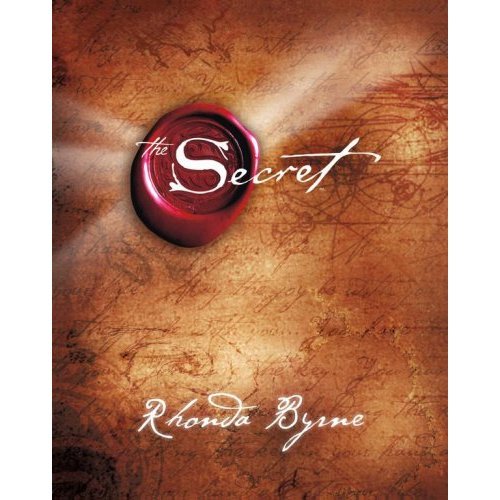
The Secret
I've just read all the way through The Secret. This book will take up the entirety of the final chapter of my thesis, and it is a fascinating object of study.
Of course, part of its interest to the literary scholar is the fact of it being so excessively - and unashamedly - intertextual. There is really very little in the book that is original prose - most of it is quotes from motivational speakers, or excerpts from much older New Thought books. This makes it a treasure-trove for me, allowing me to mine it for its influences and its references, all of which it wears very much on its sleeve.
The Secret still manages to infuriate people, and whenever I mention I am working on self-help books for my PhD, 8 people out of 10 will bring up The Secret. Such a powerful cultural artefact is a rare thing indeed, and I am always fascinated to hear why people dislike it so. They have invariably never read it, and have no idea about the social, cultural and religious movements that inform its philosophy. But its enormous popularity seems to give people some sense of ownership over it, and everyone seems to have an opinion one way or another.
My take on The Secret? Well obviously I can't give a whole chapter's worth of critical analysis here (mostly because I am yet to write that chapter!), but I see it as a manifestation of quasi-religious faith, and hope for a pleasant future in a world that offers people very little of either. Most people that read and enjoy The Secret and view the movie do not, in my experience, belong to any particular church or espouse any particular religious faith. And so the message of The Secret is something quite new to them, and something to which they can respond positively.
When I was in Melbourne recently a dear friend told me that The Secret was listed on a website called Things Bogans Like, and I was fascinated by this. Because I think that this encapsulates a large part of why self-help - and The Secret in particular - is so derided in some sectors. It is consumed by working-class people, and speaks largely to their hopes and dreams. As such it falls well outside of what is designated as high culture - particularly any kind of literary culture - and so is still open to the kind of paternalistic condemnation that other genres were once subject to.
Labels:
chapters,
criticisms of self help,
New Thought,
The Secret,
thesis
Saturday, May 8, 2010
The Science of Mind on Thought

"Thoughts of lack, poverty and limitation contain within themselves the conditions necessary to produce lack, poverty and limitation."
The Science of Mind p. 402
Labels:
books,
Ernest Holmes,
lack,
science of mind,
Thought
Tuesday, April 27, 2010
Intuition in The Science of Mind
Holmes declares that intuition is in fact the presence of God within us. If we listen to our intuition, we are in fact listening to God, and following the path of all the spiritual greats that went before us. "Intuition is God in man" he says (p. 342), and he allys it with mystical consciousness.
This consciousness, because it comes from God, is always true and eternal, and cannot harm us or lead us astray. Because it is God, it can also never be contradictory; once we experience contradiction we are in the reralm of the psychic, which Holmes derides as facile, dangerous and even cowardly. The psychic stands at the door calling, he says, while the mystic walks right inside the heart of God.
Our spiritual duty, then, is to listen to our intuitive impulses, to believe them, act on them and declare them. Once we are living intutively, we are living in full acceptance of the Divine.
Labels:
consciousness,
Ernest Holmes,
God,
intuition,
science of mind
Sunday, April 4, 2010
The Science of Mind on Spirituality
"Spirituality is not a thing; It is the atmosphere of God's presence, goodness, truth and beauty."
The Science of Mind, p. 308
Labels:
Ernest Holmes,
God,
science of mind,
spirituality
Subscribe to:
Posts (Atom)