Showing posts with label criticisms of self help. Show all posts

Wednesday, January 5, 2011

What If It All Goes Right?


Mindy Audlin was one of the founders of Unity FM, and she has invented a New Thought process called 'What If Up' that has been in use among church and corporate groups for some time now. Her book What If It All Goes Right? is a fleshing out of the thinking behind the process, and is a fascinating explication of a new spiritual technology, one that is particularly representative of New Thought thinking and expressive of the New Thought world-view.
Having recently been the featured book on Unity FM's Hooked on Classics book club, I spent quite some time reading this book, exploring the process for myself and following the exercises the book provides. This kind of involved reading, which transcends the simpler method of passive reading that is usually associated with the consumption of books, is in a way the very benchmark of the self-help process, and is the way that most self-help books are intended by their authors to be studied. Of course, whether or not the average reader does in fact extend their experience beyond the perusal of the written word is impossible to gauge. But certainly the presence of an on-line study group and the prolonged examination of the book on the Hooked on Classics radio show helped to ensure a more thorough and prolonged engagement with the text than might usually be the case.
And what is Audlin's method? Basically it's an extension of a very old idea, one set forth most strikingly in the Pollyanna story (and I must admit here that I've only ever seen the wonderful movie): instead of finding reasons to quelch an idea or tear it apart, we should instead engage in Audlin's 'What if Up' process, and think of reasons why situations, projects, goals and dreams might, in fact, work out positively. It is a brain-storming process, and one which the author keenly advises us to practice in groups. So that one person might stand in the centre of a group of supportive friends while everybody contributes a positive spin to the idea, problem or desire recently anunciated.
Audlin admits that the basic idea for this process came from her involvement with mastermind groups. Such groups evolved from the thought of Napoleon Hill, of Think and Grow Rich fame. He advised that each of us establish a core of supportive friends who meet regularly to encourage each other, share ideas, and offer each other positive emotional support. Hill thought that people with such a supportive group of peers must necessarily have greater moral and emotional strength than those who seek to do everything alone, fearing the input and derision of others.
Audlin's book works through some standard New Thought tropes, and is actually quite a concise and clear explicaton of New Thought ideals and their practical application to modern life. One of the things the author asserts is that:

"We're working with spiritual laws in a world that is goverened by cause and effect...Just don't say I didn't warn you...The universe can pack a wallop!"


Those who have been following this blog or who are keen students of New Thought & Self-Help literature will recognise two key ideas here: the notion that what is being taught is in fact an indisputable law (an assertion that goes all the way back to Mary Baker Eddy); and the recurring convention of discussing theistic ideas but replacing the word "God" with more palatable concepts like "The universe."
Along with law there is the usual attendant invocation of the notion of science, in the case of this book a surprisingly insistent one. The use of scientific language reassures the modern reader, and takes teh book's discourse out of the realms of assertion and religio-mythic ideas. But in fact much of what is discussed has its roots in nineteenth century American Protestantism.

"The subatomic substance of the universe...responding to the focus and intensity of your dominant feelings."


Now, before you write in I do not mean to poke fun at the author or the book. I am merely identifying a recurring motif that is as old as self-help books themselves - the justification of opinions by the invocation of scientific rhetoric. I would suggest that what is being described is not, in fact, a scientific truth involving subatomic substances, but a metaphysical assertion.
Interestingly, Audlin herself invokes the figure of Pollyanna:

"Let me warn you that at first glance, the techniques you will discover in this book might seem a bit Pollyannaish. You may wonder how we could possibly solve the major problems of our time with a tool that is so simple and easy to implement. Surely, our complex issues require a more complex remedy?"

But no, as you may have guessed, the book assures us that in fact what is most needed is the very simplicity and good faith characteristic of that great cultural archetype Pollyanna. The meme of Pollyanna is one regularly invoked by both critics and advocates of self-help ideas, and I really must explore this further. Perhaps in a journal article? I will have to grab a copy of the book.
This kind of reductive approach to life is, of course, characteristic of self-help, and is the source of much of its criticism. But as always, critics would be missing the point that what the book inetnds to do is not address the misfortunes and inequities of a suffering world (though later chapters invoke the notion of global healing). What it seeks to do is merely equip the individual with tools to help her achieve more and maintain a more positive and productive state of mind. And it seems to me that this is a goal that is hard to criticise. In the self-help world global change is wrought, not by collective action, but by individual transformation and its subsequent flow-on effect.
It's an interesting book and, with its heavy emphasis on practice it is ultimately a useful one. It is also, undeniably, inspirational, and in the last analysis is describing that quality that I am coming more and more to realise is at the heart of self-help thinking - the idea of grace. I think it would actually be of tremendous use to someone struggling with depression or overwhelmed by bad conditions in their life. It is unashamedly and relentlessly "Pollyannaish," and to my mind that's no bad thing.

Sunday, May 16, 2010

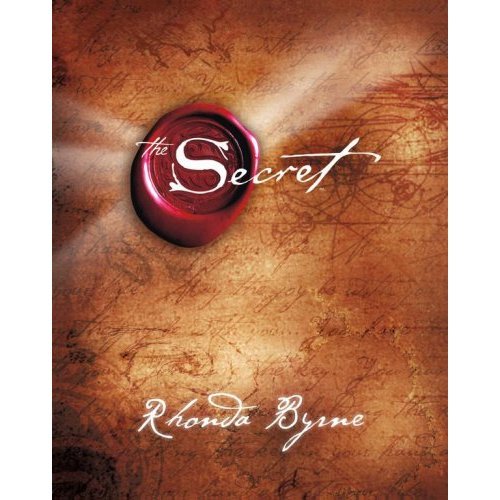
The Secret


I've just read all the way through The Secret. This book will take up the entirety of the final chapter of my thesis, and it is a fascinating object of study.
Of course, part of its interest to the literary scholar is the fact of it being so excessively - and unashamedly - intertextual. There is really very little in the book that is original prose - most of it is quotes from motivational speakers, or excerpts from much older New Thought books. This makes it a treasure-trove for me, allowing me to mine it for its influences and its references, all of which it wears very much on its sleeve.
The Secret still manages to infuriate people, and whenever I mention I am working on self-help books for my PhD, 8 people out of 10 will bring up The Secret. Such a powerful cultural artefact is a rare thing indeed, and I am always fascinated to hear why people dislike it so. They have invariably never read it, and have no idea about the social, cultural and religious movements that inform its philosophy. But its enormous popularity seems to give people some sense of ownership over it, and everyone seems to have an opinion one way or another.
My take on The Secret? Well obviously I can't give a whole chapter's worth of critical analysis here (mostly because I am yet to write that chapter!), but I see it as a manifestation of quasi-religious faith, and hope for a pleasant future in a world that offers people very little of either. Most people that read and enjoy The Secret and view the movie do not, in my experience, belong to any particular church or espouse any particular religious faith. And so the message of The Secret is something quite new to them, and something to which they can respond positively.
When I was in Melbourne recently a dear friend told me that The Secret was listed on a website called Things Bogans Like, and I was fascinated by this. Because I think that this encapsulates a large part of why self-help - and The Secret in particular - is so derided in some sectors. It is consumed by working-class people, and speaks largely to their hopes and dreams. As such it falls well outside of what is designated as high culture - particularly any kind of literary culture - and so is still open to the kind of paternalistic condemnation that other genres were once subject to.

Thursday, February 18, 2010

Spirit in The Science of Mind

Holmes says that "The spirit of man, which is his self-knowingness, is the only part of him which has volition or self-choice; all else acts as automatic law." Basically he is making a standard Christian Science-inspired division here between the Spiritual, which is of God, and therefore the only real thing, and the material body, which is gross and must fall victim to the material laws of the Universe, as must all material things. The spiritual being is eternal, the physical only fleeting, and doomed to decay.
He seems to be implying here that the spiritual is conscious of itself, but in other parts of his book he says that this spiritual consciousness is subtle and difficult to cultivate. Indeed, many people may lead a whole lifetime ignorant of the reality of their spiritual self - they may even virulently deny such an entity.

Saturday, January 2, 2010

Prometheus


Prometheus really should be the God of self-help, being the ultimate creator of humankind, and therefore representative of the creative instinct within each and everyone of us. Our desire to work on ourselves and to re-create our own identities is easily comparable to Prometheus' legend, though there are elements as well of a self-directed Pygmalion impulse - but I don't want to mix my classical references.
So it should be no surprise that self-help should be such a divisive idea, because it would seem that the Promethean idea has always inspired different, and quite opposite reactions in people. There are those who think that Prometheus was a wonderfully inventive rebel, a god determined to stick it to the other gods and create a name for himself. In this pro-Promethean camp I would place all the writers, readers and exponents of self-help. In a book I've just been reading called The Divided Self of William James, author Richard M. Gale describes the fascinating Mr. James as possessing a "Promethean pragmatism."
But others (and Mary Shelley springs to mind here) take the view that Prometheus was an overly-optimistic, monstrously self-obsessed meddler in nature. He had no right to attempt to create a new destiny, all of his attempts being foolish and misguided and ultimately disastrous.

Wednesday, October 28, 2009

Self-Help, Inc.


One of the most substantial studies of self-help books, and certainly the most recent, is Micki McGee's engaging Self-Help, Inc.
McGee is an academic, and takes a thoroughly academic approach to her analysis of self-help books. Her critique seems to be informed by Marxist theory, and he basic thesis is that self-help books mostly encourage workers to accept poor wages and working conditions, and to blame themselves for these material shortcomings.
While I don't necessarily agree with McGee's thesis (though she certainly argues it convincingly, and I think that many of her assertions are valid), I love her passion for the genre, and the degree to which it fascinates her.
The book is well-written, and superbly referenced and argued. As an academic resource it is faultless, and is certainly the main critical reference point for my own PhD.
McGee is most interesting when she talks about the different ways work is conceived in the literature of self-help. Along with Weber (who she seems to have a real understanding of), she says that the older Western notions of religious vocation and calling were transferred in the Protestant world to the areas of work and moneymaking. She sees mystical overtones in Nelson Bolles' What Colour is Your Parachute, and provides an interesting analysis of Julia Cameron and The Artist's Way (a book that interests me because of its overtly religious rhetoric).
McGee sees the growth in popularity of self-help as a negative thing, reflecting an increasingly solipsistic tendency in the Western mind. People who may once have committed themselves to social causes and societal change instead focus on transforming themselves, a work which is all-consuming and never-ending.

Tuesday, October 20, 2009

Self-Help Nation


I've been reading a rather jaundiced critique of self-help called Self-Help Nation, by one Tom Tiede.
There is a whole sub-genre of books criticising self-help books, Steve Salerno's fascinating SHAM being the most recent example. I find it interesting that most of these critics seem to come from the right of the political spectrum, though in general those people vehemently opposed to self-help come from all sides of politics. It must just be the conservatives who can cultivate enough wrath to get it all down on paper.
Mr. Tiede's book is quite a good read, apart from the inexplicable inclusion of his poetry, which I naturally skip. Oh, the inordinate vanity of authors who imagine that its ok to slip some of their sup-par poetry into a work of non-fiction. He can be funny, though he can also drag the joke on for rather too long. And while I concede that self-help writing does indeed represent a rich mine of things to make fun of, I do think it is rather a soft target. Mr. Tiede's complete contempt for the books he is analysing is, to my mind, a rather too-easy pose, requiring the author not to think too seriously about the texts he is condemning.
His criticism is quite standard - that self-help books are unrealistic and cause a dangerously overblown set of expectations to rise up in the hearts of the readers. He says they are too simplistic, and is fascinated by the semi-magical numerology of self-help solutions: four steps to relationship success, seven days to true riches etc. He also includes a rather peculiar chapter in defence of addiction, which I quite enjoyed if only for its sheer audacity and lack of political correctness.
But occasionally he makes statements that are downright offensive and simply stupid - declaring, for example, that he'd rather be leading a poverty stricken existence in Burkina Faso than earning a living advocating self improvement. He also gives away rather more than I think he intended, providing a fascinating insight into his psyche, and the reasons why he finds the ideas of self-help so threatening that he had to write a whole book condemning them. In a particularly touching passage he writes about his own problematic relationship with his father, and ironically it is at this moment of tenderness, honesty and self-confession that he is at his literary best.