Showing posts with label book reviews. Show all posts

Tuesday, January 8, 2019

Creativity: Some reading notes

Readers, I have had a rather dull and painful holiday period.

I had the flu most of December, and then in the final days of the year I had a tooth extraction which was rather traumatic and left me in horrible pain. I am still recovering from that. Rather unsurprisingly it has left me hesitant to go out at all, so I have been spending a lot of time at home, catching up on my reading and thinking about my creative life. Also, Sydney is horribly hot and humid at this time of year, so one doesn't really need an excuse to stay at home in bed with the aircon on. 

One book I have been reading for an important creative reason is Jay Baer's Youtility. I really hope to have a couple of books out in the next 18 months, and I have been thinking about how I can build their marketing into the creative process itself. Baer's book just jumped out at me as the one to really inspire me to think laterally when it comes to marketing and promotion, and so far it is absolutely filled with good advice. It's all about attracting readers (customers) by being helpful and genuinely interesting.

Travel writing has been a favourite genre of mine since I was a teenager  - I suppose that is why I became a travel writer! One travel book that I have long been fascinated with is Patrick Leigh Fermor's A Time to Keep Silence, a wonderful account of a young man visiting monasteries in Europe. I have picked it up again because I have finally decided to write another book about Vietnam (I am quite excited about this) and this is really my inspiration. It is quite a perfect little book, and if I could write something even half as good as it I would be doing well.

And on matters travel, Charles Dickens wrote two travel books quite early in his career: American Notes and, later, Pictures from Italy. These are often collected into one volume, and I am reading such a volume right now. The main reason is because these two books together represent the Book of the Year for 2019 at the NSW Dickens Society - of which I am Vice president. But even more importantly, I have to give a talk on them on Saturday June 1, 2019. It is interesting to see how seriously he took travel, making sure that, almost as soon as he arrived in America, he was off visiting institutions and educational places so that he could report back to his readers in England about them. No hanging about in the hotel room reading a book for Mr. Dickens!


Some spiritual creative sustenance for me with The Seeker's Guide by Elizabeth Lesser:

"Some hear the word spiritual and are encouraged by its whispered promises of grace; others are threatened by it, afraid of looking too deeply at their own behaviour, the unlived parts of their life, and ultimately, death." 


Another creative project I have begun researching in earnest is a book about the Ascended Masters, and to that end I have been reading an utterly fascinating book called Masters of Wisdom by Edward Abdill. Its subtitle is: "The Mahatmas, their letters and the path," and it is a brilliant read combining occult wisdom, historical gossip and some really deep-seated exploration of figures (and ideas) that very few people know about anymore.

Wednesday, December 2, 2015

Todd Henry's Die Empty - a review


I don’t think I have ever endorsed a book with such a controversial title. For me it is without any import – I rather like the idea of dying empty, having used up each and every ounce of creativity and passion. But a surprising number of people react negatively to the title and the concept. I have used this book several times now teaching creativity courses, and there is always one or two people who shrink from the title.

If you are one of those, I apologise, but I also urge you to overcome you initial reaction because Todd Henry’s book is really quite exceptional and has been a major source of creative inspiration to me for some time now.

Todd Henry


In Die Empty, Todd Henry offers some indispensable advice on avoiding the aimless life and recognising the potential for happiness here and now. Henry is one of those ubiquitous modern marketing gurus in the Seth Godin mould who have sprung up in the age of podcasting and social media with a unique style of life and career advice specifically aimed at a media and technology savvy generation. He is always interesting, and never more so than in this book.

It is also quite brutal advice, encouraging people not to be self-deluded. Henry offers the example of the hapless, hopeless contestant of the TV reality talent show, the one destined for the “worst of” show who is surrounded by well-meaning mothers and friends who encourage them in their delusions. Yes, well have innate talents, but in any cases these talents require a great deal of careful discernment, and can potentially be overshadowed by externally-imposed (or confected) dreams of greatness.

Neither is success necessarily about wealth or possessions. Henry is not of the “3 Ferraris” school of motivation, with a cheque for a million dollars pasted up on one’s ceiling. Not that there’s anything wrong with wanting some sort of material comfort, it is just that Henry suggests much of what fulfils us and uses our greatest talents may not necessarily be big moneyspinners. It is ultimately more important to create energising personal narratives built around more lasting motives.

Henry advises us all to take “small, calculated risks” each day in our quest to become greater and to be of greater use in this world. It is passion for our actions that drives us and makes us happy. The age of duty is perhaps over, at least for those of us living in the more privileged world. If we are not bound to take on work that will support our families and guarantee their welfare then we find our moral obligations in other places, principally in the direction of those vocations where we find ourselves belonging. Our moral duty has shifted to an obligation to make the most of our talents, and to use them in life-celebrating and fulfilling ways. To ignore these talents and focus instead on a mundane life is its own sort of sin.

It’s a challenging book, as the title indicates, and is not for readers who want to look for excuses. Henry tells us we have to acknowledge the areas of resistance in our lives (echoes of Steven Pressfield’s work here) and move on through them. Perhaps at heart we all want to be great, or at least to contribute something to the greater good of humanity reading Die Empty might make you start taking this destiny more seriously, and convince you to start planning the final years you have left. An uplifting and motivating read, this is a book I am certain to return to again. Check it out.

Friday, July 13, 2012

Reading Success Literature

Success is such a bold word, and one which is traditionally associated with the literature of self-help. The great magazine of the self-help movement is called Success, and it is a quality which perhaps best describes the way we all want to be seen this world: as successful people. Those approaching life with an attitude of self-development often choose to see the human journey as a series of successes, opting to maintain "an attitude of grattude" which triumphs at even the smallest gains. Success, so the self-help books tell us, is its own reward. And it seems as though this conviction has been a part of Western culture since antiquity. As the Roman emperor Marcus Aurelius put it:

"Forward, as occasion offers. Never look round to see whether any shall note it... Be satisfied with success in even the smallest matter, and think that even such a result is no trifle."

So, here are a few books from my collection that specifically address success:


The Truth About Success and Motivation by Dr. Bob Montgomery - This 80s book by a Melbourne doctor is quite charming and gruff, and one of the few self-help books with a uniquely Australian voice. Dr. Bob thinks that being assertive might be the key to success.


50 Success Classics by Tom Butler-Bowden - The ultimate collection of books specifically about success, Butler-Bowden provides detailed precis of 50 of the best, providing an invaluable reading guide. In it he included the Chinese classic, Sun Tzu's The Art of War.


Your Success in Five Years or Less by Anita Bell - Another Australian, Anita Bell defines success in terms of real-estate investment culminating in financial independence. In it she describes how she bought her first block of land at the tender age of 16. Quite an amazing lady.


Authentic Success by Robert Holden - I heard Holden speak last year at the Hay House I Can Do It conference in Sydney and he was thoroughly charming. He's kind of cheating a bit here - he is asking the reader to re-define success so as to be able to live a calmer, more balanced life.


Character is Capital by Judy Hilkey - This is a fascinating academic study of the "success manuals" that were sold door to door in nineteenth century America. Hilkey tells us that these early success writers created in their texts a vision of a deeply polarised world which gave birth to a great anxiety about moving up in the world.


The Success Principles by Jack Canfield - Canfield is of course the man behind the Chicken Soup for the Soul franchise, and this enormous book is jam packed with practices and ideas that he claims will guarantee success. I  have actually read this book a few times, principally because it is well writen and constructed, and those ideas that I have actually put into place (shamefully few) actually seem to work. Canfield tells us that we should create our To Do lists the night before, just before we go to bed. This way we can start the day running, ticking off the items as we work toward our goals.


Success is Not an Accident by Tommy Newberry - Newberry says we need to write down really compelling goals in order to be successful. 


Wednesday, October 26, 2011

Peace in the Present Moment


Peace in the Present Moment is a beautiful little hard-covered gift book, and it is a meditation experience all on its own. The words of famous New Age writers Eckhart Tolle and Byron Katie are matched with the most incredible flower photographs of Michele Penn - photos that are described as "soul shots" of flowers.
It's a beautiful introduction to the world-changing work of these two authors, offering the reader nice digestible chunks of their wisdom which will almost certainly cause you to investigate their writings further. The quotes in the book are all from Eckhart Tolle's Oprah-changing international bestseller A New Earth and Byron Katie's less well-known A Thousand Names for Joy (a book I happen to like very much).
The book begins with a lovely, lyrical introduction from Stephen Mitchell, acclaimed translator and Katie's husband. In it he talks about the flower as symbol of enlightenment, and provides the loveliest quote from Iris Murdoch:

"People from a planet without flowers would think we must be mad with joy the whole time to have the things about us."


Isn't that beautiful? I am already something of a stopper-and-admirer of flowers, but that has encouraged me to cherish flowers even more for the wonderful little miracles that they are.
Some of my favourite quotes from the book:

"There is a perfection beyond what the unquestioned mind can know. You can count on it to take you wherever you need to be..." Byron katie

"When you hate what you are doing, complain about your surroundings, curse things that are happening or have happened, or when your internal dialogue consists of shoulds and shouldn'ts, of blaming and accusing, then you are arguing with what is, arguing with that which is already the case. You are making life into an enemy and life says, "War is what you want, and war is what you get."" Eckhart Tolle


This book would make a lovely gift to a more spiritually inclined person.

Friday, July 15, 2011

The War of Art


When this book came out I was working in a new age bookshop, and it was one of those titles that come out of nowhere - no hype, no warning, just suddenly everyone was calling up and ordering it. I wasn't much interested then - the title kind of put me off, and I assumed it was aimed purely at visual artists.
Fast forward four years or so, and the author, Steven Pressfield, has shot to prominence one more with his rather daring new book Do the Work. Endorsed by Seth Godin, published by Amazon & Godin's new outfit The Domino Project and sponsored by GE, it represented a whole new type of book. I haven't read it yet, but am very keen to.
But all the renewed talk of Pressfield brought The War of Art to prominence once more, and after listening to him interviewed on a couple of podcasts, I knew I had to get it.
And yes, having read it I have become, instantly and unchangeably one of the members of the cult of Pressfield.
Put simply, this book will change your life and the way you look at your work. A few pages in I was shaken by how simple and how true it all was. It was as though the author was writing specifically about me and my own life history. And the thing is, EVERYONE says the same thing about the book. It really is that extraordinary.
What is its central message? That we all have a "work" within us that we were put on this earth to do, and unless we start doing it our lives will be frustrating, unhappy and ultimately destructive. Pressfield says that the task we resist the most is the one we are meant to do, and that we should do it first thing every day, thereby fulfilling our sacred role on earth.
And you don't need to be an artist, a writer or an opera singer to be able to get something out of this book. Pressfield is adamant that we all have an important task to do, even if it isn't what society would call "creative." Whatever you feel called to do - dance, travel, teach or (Pressfield's favourite example) run a plumbing business - you need to get out there and start doing it now. Your life depends on it.
I was so inspired by this book, but also gained some solid practical advice from it. He suggests we treat ourselves as our own company, and every Monday morning have a weekly task meeting for ourselves, writing out our list of jobs and duties that need to be completed by the end of the week, I am definitely going to start doing this.
The dangers that threaten to steer us from our true course are legion, and Pressfield is merciless in demanding that we jettison all of them. From being overly-sensitive to criticism to being lost in procrastination, The War of Art identifies all of these as traps, as part of the "resistance" that we cultivate, and allow to drive us from our best work .
You simply must read this book. It is by far the most inspirational book I have read in many years, and it has already had a huge effect on my life and output. All writers and creative workers will benefit from its advice.
The man is a genius.

Tuesday, July 12, 2011

Discover the Gift


Discover the Gift by Shajen Joy Aziz & Demian Lichtenstein

This is the kind of product that will be instantly recognisable to many – it is a book to accompany an inspirational film, a genre established simultaneously by The Secret and What the Bleep Do We Know.

And as in both of those 2 instances, the book stands alone as its own inspirational and motivating read. I was drawn in almost from the beginning as the brother and sister authors told their own personal stories of alienation and then renewed love and closeness.

And, like The Secret, Discover the Gift brings together some really big spiritual teachers who talk about our reasons for being on this earth. Not just a movie, not just a film, the authors describe this as a MOVEMENT! Some of the featured teachers include: Barbara De Angelis, the Dalai Lama, Sri Sri Ravi Shankar, Mary Manin Morrissey and my personal favourite Michael Bernard Beckwith.

So we’re in something that’s very much an established and popular tradition tradition. But that’s not to say that it’s not good – it is. Very stimulating, incredibly inspiring. Let’s face it, we always need reminding of these ideas:

  • · That choice is possible, and that our choices direct our lives

· That life is the most precious, wonderful gift

· That we need to express our gratitude for all of the wonderful things in our lives

That we need to practice more solitude and focused thinking

The Book describes 8 Distinct Universal Spiritual Steps:

1. Receptivity

2. Intention

3. Activation

4. Feedback

5. Vibration

6. Adversity and Transformation

7. Compassion

8. Love

I particularly loved Jack Canfield’s contributions – he's the Chicken Soup for the Soul man, and if you haven’t read his newer book The Success Principles I really recommend it, as it will change your life. In Discover the Gift he is talking about establishing newer, more positive and productive habits in our lives, jettisoning the old conditioning.

One of the authors, the sister, Shajen Joy Aziz, stresses the importance of constant action in pursuit of our gift. Too often we let our talents lie fallow, when we should be employing them every day. She urges to do one thing, no matter how tiny, to keep the momentum of our dreams, and to keep us on that path of realisation.


Wednesday, June 22, 2011

"Am I Going Mad?" by Marlyse Carroll


More than anything, Australian author Marlyse Carroll's book Am I Going Mad? offers a very nice overview of psychology, incorporating lots of the ideas of Jung and criticising the western mania to label things as “sick” when they are merely different or a little difficult. Marlyse points out that the spiritual journey has always been a difficult one, with many phases along the way, but in recent years we have been encouraged to think that somehow any divergence from the norm is somehow “sick.”

She tells lots of wonderful stories – some of them quite distressing and outrageous – based on her own experiences. These are often quite archetypal in nature, reflecting the universality of the Jungian journey. She also recounts some wonderful experiences, like learning to dance as a simple expression of the soul.

The overwhelming message of the book is that fundamentally Jungian one of embracing the shadow self.

The whole book is describing the intense spiritual journey in a very honest way, highlighting the challenges and the pitfalls, and assuring the reader that they are all worth it. Carroll is actually a solid and scholarly writer, and this book is quite serious in its intent. She draws from many of the best spiritual, psychological and scientific thinkers to present this overview, and it is really quite an impressive effort.

She sites mystical consciousness (as opposed to mental illness) in Jung’s described space of the transpersonal. At least, I think I got that right - like I said, this is weighty stuff.She also incorporates ideas of kundalini, using the chakras to illustrate the stages of a person’s journey towards true selfhood.

Chapter headings include:

·

"How do we know when we experience an archetypal encounter?"

· "Science and spirituality" ( how many physicists are almost mystics, and how the two subject areas almost meet at the other end)

· "Nothing ever happened!" (how so often we stop halfway along the spiritual journey, sometimes totally rejecting it because we are tired or afraid or it has shaken things up too much. Jung recognised this as a common event).

· "Use wisely the extra physical energy now at your disposal."

From the author's website:

Finally, a book that sheds light on the dark side of spiritual evolution...

A book that bridges science and spirituality in an entertaining way!

This work has mostly taken place through the INNER PEACE Institute for Wellbeing, a non-sectarian educational organization based in Melbourne, Australia. Founded in 1995 by my husband Michael Carroll and I, its aim is to teach meditation, spirituality and wellbeing.

Practical information relating to the subject of spiritual evolution and its crises.

Thursday, May 26, 2011

"The Map of the Soul" by Tricia Brennan


I have noticed lately that one of the more significant trends in self-help books is the elevation of intuition as the main force behind finding one's true life purpose. Australian Paul Fenton-Smith has just published a book called Intuition, and British author Angela Donovan has written a book called The Wish which sets about helping the reader get into touch with her intuititive side.
Adding to the zeitgeist is this handsomely produced new book from Australia's Rockpool Publishing. Tricia Brennan, the author, is described as an "intuitive counsellor" and the entire book is about using intuition to help recognise the forces and conditions that most fully resound with your life's central purpose.
It is a rigorous 12 level program for personal discovery, and I think that following such a program would indeed prove enormously beneficial. It is certainly a book meant to be read over an extended period, as each level requires a signifcant commitment of time and personal exploration. Brennan is a geat exponent of many of my own enthusiasms, including journalling, meditation and the use of affirmations.
The central premis of the book is that we need to get into alignment with our "Authentic Self" - the premise of many self-help books, of course, and one that intrigues and perplexes those who don't understand the genre.
This isn't really the kind of book to buy and read on the train. It requires a large amount of practical engagement, and following the program would appear to be a significant commitment.
Brennan is a subtle writer, and she explores the different shades of self-enquiry with sensitivity and intelligence. She is also not a propnent of self-indulgence, as is evidenced when she says:

"Feeling genuinely compassionate toward yourself is what alters negative behaviour - not self-pity but compassion."


A fine point, and one worth making.
How do we shift our lives "from mediocre to magical?" Uncover a practical plan to lead us toward our true purpose in life? Discover once again the great depths of meaning in which we used to dwell? Tricia Brennan's practical book will show you how.

Wednesday, January 5, 2011

What If It All Goes Right?


Mindy Audlin was one of the founders of Unity FM, and she has invented a New Thought process called 'What If Up' that has been in use among church and corporate groups for some time now. Her book What If It All Goes Right? is a fleshing out of the thinking behind the process, and is a fascinating explication of a new spiritual technology, one that is particularly representative of New Thought thinking and expressive of the New Thought world-view.
Having recently been the featured book on Unity FM's Hooked on Classics book club, I spent quite some time reading this book, exploring the process for myself and following the exercises the book provides. This kind of involved reading, which transcends the simpler method of passive reading that is usually associated with the consumption of books, is in a way the very benchmark of the self-help process, and is the way that most self-help books are intended by their authors to be studied. Of course, whether or not the average reader does in fact extend their experience beyond the perusal of the written word is impossible to gauge. But certainly the presence of an on-line study group and the prolonged examination of the book on the Hooked on Classics radio show helped to ensure a more thorough and prolonged engagement with the text than might usually be the case.
And what is Audlin's method? Basically it's an extension of a very old idea, one set forth most strikingly in the Pollyanna story (and I must admit here that I've only ever seen the wonderful movie): instead of finding reasons to quelch an idea or tear it apart, we should instead engage in Audlin's 'What if Up' process, and think of reasons why situations, projects, goals and dreams might, in fact, work out positively. It is a brain-storming process, and one which the author keenly advises us to practice in groups. So that one person might stand in the centre of a group of supportive friends while everybody contributes a positive spin to the idea, problem or desire recently anunciated.
Audlin admits that the basic idea for this process came from her involvement with mastermind groups. Such groups evolved from the thought of Napoleon Hill, of Think and Grow Rich fame. He advised that each of us establish a core of supportive friends who meet regularly to encourage each other, share ideas, and offer each other positive emotional support. Hill thought that people with such a supportive group of peers must necessarily have greater moral and emotional strength than those who seek to do everything alone, fearing the input and derision of others.
Audlin's book works through some standard New Thought tropes, and is actually quite a concise and clear explicaton of New Thought ideals and their practical application to modern life. One of the things the author asserts is that:

"We're working with spiritual laws in a world that is goverened by cause and effect...Just don't say I didn't warn you...The universe can pack a wallop!"


Those who have been following this blog or who are keen students of New Thought & Self-Help literature will recognise two key ideas here: the notion that what is being taught is in fact an indisputable law (an assertion that goes all the way back to Mary Baker Eddy); and the recurring convention of discussing theistic ideas but replacing the word "God" with more palatable concepts like "The universe."
Along with law there is the usual attendant invocation of the notion of science, in the case of this book a surprisingly insistent one. The use of scientific language reassures the modern reader, and takes teh book's discourse out of the realms of assertion and religio-mythic ideas. But in fact much of what is discussed has its roots in nineteenth century American Protestantism.

"The subatomic substance of the universe...responding to the focus and intensity of your dominant feelings."


Now, before you write in I do not mean to poke fun at the author or the book. I am merely identifying a recurring motif that is as old as self-help books themselves - the justification of opinions by the invocation of scientific rhetoric. I would suggest that what is being described is not, in fact, a scientific truth involving subatomic substances, but a metaphysical assertion.
Interestingly, Audlin herself invokes the figure of Pollyanna:

"Let me warn you that at first glance, the techniques you will discover in this book might seem a bit Pollyannaish. You may wonder how we could possibly solve the major problems of our time with a tool that is so simple and easy to implement. Surely, our complex issues require a more complex remedy?"

But no, as you may have guessed, the book assures us that in fact what is most needed is the very simplicity and good faith characteristic of that great cultural archetype Pollyanna. The meme of Pollyanna is one regularly invoked by both critics and advocates of self-help ideas, and I really must explore this further. Perhaps in a journal article? I will have to grab a copy of the book.
This kind of reductive approach to life is, of course, characteristic of self-help, and is the source of much of its criticism. But as always, critics would be missing the point that what the book inetnds to do is not address the misfortunes and inequities of a suffering world (though later chapters invoke the notion of global healing). What it seeks to do is merely equip the individual with tools to help her achieve more and maintain a more positive and productive state of mind. And it seems to me that this is a goal that is hard to criticise. In the self-help world global change is wrought, not by collective action, but by individual transformation and its subsequent flow-on effect.
It's an interesting book and, with its heavy emphasis on practice it is ultimately a useful one. It is also, undeniably, inspirational, and in the last analysis is describing that quality that I am coming more and more to realise is at the heart of self-help thinking - the idea of grace. I think it would actually be of tremendous use to someone struggling with depression or overwhelmed by bad conditions in their life. It is unashamedly and relentlessly "Pollyannaish," and to my mind that's no bad thing.

Sunday, November 21, 2010

"This Thing Called You" by Ernest Holmes


Ernest Holmes, founder of the Church of Religious Science and all-round California legend, was a prolific writer. Indeed, Holmes seems to have been an overachiever on almost every front - he was a tireless preacher and self-promoter and established a religious empire which continues to have an affect on contemporary popular culture. Of course, his magnum opus The Science of Mind is a book I've been reading slowly all year and blogging along the way. This Thing Called You is a much smaller work, a slim book made up mainly of affirmations, meditations and prayer treatments intended to improve the reader's life and strengthen her sense of living spiritually.
And where The Science of Mind, a vast book in every sense, tends toward the wordy and prolix, this smaller book is actually quite elegant and sparse, setting out in simple language Holmes' own views on how exactly the Universe (not my capital "U") functions. Indeed, it is a terrific read at times, inspiring and thoughtful, providing a very clear and practical path of spiritual practice.
In every piece of Holmes' writing that I have read thus far it is clear that his philosophy owes a debt primarily to Emerson and Mary Baker Eddy (though probably through the medium of her student and later rival Emma Curtis Hopkins). Indeed, he is free in his references to Emerson, as are most New Thought writers. He is less forthcoming in his recognition of the guiding hand of Eddy - if she is mentioned at all it is in elliptical and disapproving references.
The book's primary theme is, as always, that each of us represents the Universe in its entirety, that, to quote Emerson (as Holmes does) "...every man is a doorway to the inifinite." This infinitude which we represent (and which we are, at the most basic level) needs only to be awakened to. We need not go on any spiritual search, says Holmes, because:

"...the thing you are after is already here, within you. The only things that stand between you and it are the accumulated thoughts, beliefs and emotions of the ages" (p.13).

More than a slight impediment, one would imagine, but Holmes is eternally optimistic that the human is moving ever forward (or should that be inward) toward full knowing of her own divinity. Holmes says that the problem of our future lies not in being selfish or unfairly possessed of good fortune. The real problem is that we do not wish for more and better for ourselves and others. Our wishes, desires and thoughts create our own reality, and so communal ideas (memes, I suppose we'd call them now) are merely these same false constructs writ large. Poverty and suffering exist only because we continue to acknowledge their reality. All that is good and perfect already exists - is, in fact, all that is real - we have simply failed to arrange the world and our lives in the correct way. Holmes advocates not revolution, but the rearrangement of mental furniture (p.17).
We encounter exactly those things we imagine, says Holmes, "If you believe that wherever you go you will meet with love and friendship, with appreciation and gratitude, then this will become...your law" (p. 18). This is, of course, a classic New Thought assertion, and it also speaks of exactly the sort of folk wisdom common not only to early twentieth century Americans, but to most of us now. Common sense and theological assertion, however, do not make for much of a scientific case, and those more cynically minded might be happy to point towards plenty of examples of the gullible and the kind meeting sticky ends, despite their best feelings.
But Holmes would stand his ground, I imagine, and in this book brooks no oppositional voice, nor even raises the spectre of an alternative (and much less comforting) viewpoint. For the practitioner of Science of Mind, as for all of the early exponents of New Thought, it is the matter of belief which shapes our physical world, our mental universe, and the reality we continue to experience. It may be cold comfort, but for the experiencer of misfotune, harrassment or slander, Holmes' has simple and constant advice:

"...everything in your life depends on belief...it is done unto you as you believe. Change your belief and you can change your world" (p. 25).


Monday, October 25, 2010

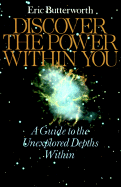
Eric Butterworth - Discover the Power Within You


Eric Butterworth was one of the most influential New Thought preachers of the mid-twentieth century, as well as being a prolific author. His influence on the Unity movement was enormous, and continues to the present day. Unity FM has just started a whole radio show devoted entirely to the teachings of Butterworth, and recently the 'Hooked on Classics' book club on that same station studied his 1968 classic Discover the Power Within You.
It is actually quite an impressive work, a carefully laid-out view of New Thought spirituality, especially the central notion that "You ask for success by getting into the consciousness of success" (p.114). Butterworth was obviously a great scholar, and his writing is based on an easy grasp of literature and religion. Despite its corny title, this is actually quite an erudite work, and its argument quite compelling.
Butterworth excels at putting some pretty difficult New Thought notions into plain language, evincing a grasp of aphorism and folksy philosophy that is a very old part of American literary culture. The book is intended as a practical guide, and so encourages people to apply their spiritual views to their daily lives. Reading the book one is constantly discovering areas in which the author seems to be speaking directly to us. I am also conscious that he is enunciating New Thought philosophies that date back to Mary Baker Eddy, though with far more accessible language. For example:

"When we realize that evil is simply the concealment of good, then any person who is unloving, vicious, or unjust is actually a person who is good but doesn't know it. In a very real way, we can change him - at least as far as we are concerned. We can see him with the "single eye" that relates only to the good and the true" (p. 124).


This is basic Christian Science thinking - that there is only goodness in God's creation, and that all of us, being a part of this creation, must at heart be good. The error is in the seeing; we choose to see bad. It is a challenging philosophy, and one difficult to apply, but I think Butterworth describes quite a noble effort in this passage.

One of the constant criticisms I hear about self-help books is that they pander to the selfish side of humanity, that they encourage materialism and tacky consumerist desires. This frustrates me because any careful reading of almost any self-help book exposes a constant injunction to develop the spiritual above all other attributes, and to see growth in metaphysical rather than materialist terms. It is a point that Butterworth himself drives home over and over again: "Success cannot be measured by what you have amassed" (p.131). This is, above all, a devotional work, a book that is about the development of a complete spiritual worldview, the growth of a soul. As such it illustrates perfectly one of the central points of my thesis, that self-help books are in fact quasi-religious texts that offer practical moral teachings and metaphysical worldviews.

The author has sought with this book to describe a practical, progressive and positively-focused Christianity. There is a surprising amount of theology in the book, much of it of a decidedly Girardian flavour. I know that would shock my academic friends, but I stand by my assessment. Butterworth's book is a lyrical, complex and deeply thoughtful text which challenges the authority of mainstream Christianity, as well as the easy laziness of reflexive individualism and the unexamined life.

Tuesday, September 7, 2010

Ask Yourself This - Wendy Craig-Purcell


Ond of the podcasts I listen to religiously is Unity FM's Hooked on Classics. It is a weekly book club that examines books by and about the Unity Church and New Thought. From the point of view of my thesis writing it is a valuable process, because it really examines New Thought ideas in depth, and from a number of different perspectives. On a personal level, I enjoy the whole process of reading a book very closely over a couple of months and hearing it analysed week-by-week. I've always wanted to be in a book group, but my insane schedule doesn't allow for it. This is the perfect compromise.

One of the books recently studied was Wendy Craig-Purcell's Ask Yourself This. Craig-Purcell is a Unity Minister, and spoke about her own book on several of the shows. Needless to say I found this a prticularly fascinating exercise, a kind of anti-Barthesian commentary that actually says a lot about self-help writing and it's excessive intertextuality and self-referencing.

The premise of the book is that it represents a series of personal questions that the reader should ask herself. These questions are challenging and are meant, naturally, to facilitate personal and spiritual growth. As well as exploring the questions at length in print, the reader is also asked to meditate on each question and to journal on the reflections, thereby deepening the impact of the reading process.

The questions are not particuarly innovative or unusual, but they are broad enough to be quite challenging to answer, and spending time in wondering about them causes any number of additional questions to be formed in the mind of the engaged reader. Questions include such things as:

"What am I looking for?
Who am I trying to change?
If I knew I would be successful, what would I be saying "yes" to?"


The final chapter of the book is a peculiar diversion into the area of home schooling, something about which the author is passionate. Home schooling is a hot topic in America, and Craig-Purcell is keen to explore it as a religious person who is neither conservative nor fundamentalist. I must say that this section seems to sit awkwardly with the rest of the book, however, and for this reader at least added nothing to the process being explored. And certainly in Australia, where home schooling is a non-issue, this whole bit can profitably be ignored, and the book be wound up at the end of chapter 7.

Ask Yourself This is interesting because it is not a practical self-help book. Published by Unity House, the Unity School of Christianity's own publishing arm, the book is decidedly spiritual in bent, and the questions are intended to inspire prayer and reflection rather than specific action. This leaves the whole process of reading the book and folllowing its suggestions a much more open-ended process, and one I think would be quite attractive to many readers, particularly if they are of a more mystical bent.

I enjoyed the book, and interestingly I read most of it while I was on retreat at a Benedictine monastery, and it was the perfect companion on such an occasion. Slim and easy-to-read, Ask Yourself This is an excellent primer in New Thought and a nifty text for helping the reader to explore some of the more challenging (and more grandly focused) spiritual niches of the mind.