Showing posts with label materialism. Show all posts

Saturday, March 19, 2011

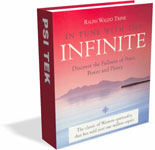
In Tune With the Infinite - Ralph Waldo Trine


I am slowly working my way through the classics of New Thought, and have just finished what is probably the grandaddy of them all, Ralph Waldo Trine's 1897 In Tune With the Infinite.
In Tune With the Infinite is one of those books that you see referenced everywhere. Quotes from it regularly start chapters of New Thought books, and Trine's name is invoked even now in all kinds of self-help books. In Tune With the Infinite was motor magnate Henry Ford's favourite book of all time, and he gave copies of it to all of his executives, insisting they read it. Ernest Holmes, founder of the Church of Religious Science, was great fan of Trine's work, and to date In Tuune With the Infinite has sold over 2 million copies.
That said, it is not an easy book to read. Written in the slightly flowery language of its day, In Tune With the Infinite probably deserves some more careful re-reading to get past its stylistic failings. And yes, I acknowledge that it's foolish to criticise an author for conforming to the literary conventions of his day, just because expectations are different now. I just feel I should warn prospective readers that an amount of patience is needed when reading the book. Though not long, it is packed with ideas, and really is in many ways the sourcebook of New Thought teaching.
Trine was s tudent of world religions, and one thing that really does shine through the book is his deep indebtitude to the ideas of the Eastern faiths, particularly Hinduism and Buddhism. In many ways In Tune With the Infinite is a reworking of the doctrine of karma, rendering it in a more theistic way and making the idea more palatable to a Western mind trained in conventional Christian ideas.
And like most New Thought writers of the time (and since), Trine was keen to emphasise that he was not advocating a new religion or a new set of dogmas and fanciful supernatural ideas. He advocated rationality in the face of the mystical, and the book is surprisingly free of the overtly devotional language that one encounters when reading Charles Fillmore or any of the later New Thought writers. He saw the new attitude as one of science and reason yoked to a spiritual vision based on quite a sophisticated understanidng of God and the universe:

"Reason is not to be set aside, but it is to be continually illumined by this higher spiritual perception, and in the degree that it is thus illumined will it become an agent of light and power."

An advocate of science and reason, Trine could also see the dangers of a more thourough materialism, and wanted his readers to negotiate a western Middle Way between the two. And while convinced of the infinite possibilities of the human mind, he was also no advocate of magical thinking. Like his more stolid Victorian forebears, people such as Samuel Smiles, he endorsed hard work as the very best way to ensure happiness, prosperity and good fortune.
Self-help critic Micki McGee suggests that Trine's work popularised the transcendentalism of his namesake Ralph Waldo Emerson, and melded it with a more materialist philosophy, the fusion becoming the very essence of New Thought.
"Thoughts are forces, subtle, vital, creative, continually building and shaping our lives according to their nature" says Trine, setting out clearly what would become the ultimate trope of self-help writing until the present day - the notion that our material reality is a product of our own thinking. As problematic an assertion as that is, it is one that carried (and continues to carry) an immense cultural power, and Trine's influence on the modern imagination and concepton of the self has been greatly undervalued.

Monday, October 25, 2010

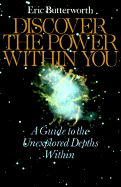
Eric Butterworth - Discover the Power Within You


Eric Butterworth was one of the most influential New Thought preachers of the mid-twentieth century, as well as being a prolific author. His influence on the Unity movement was enormous, and continues to the present day. Unity FM has just started a whole radio show devoted entirely to the teachings of Butterworth, and recently the 'Hooked on Classics' book club on that same station studied his 1968 classic Discover the Power Within You.
It is actually quite an impressive work, a carefully laid-out view of New Thought spirituality, especially the central notion that "You ask for success by getting into the consciousness of success" (p.114). Butterworth was obviously a great scholar, and his writing is based on an easy grasp of literature and religion. Despite its corny title, this is actually quite an erudite work, and its argument quite compelling.
Butterworth excels at putting some pretty difficult New Thought notions into plain language, evincing a grasp of aphorism and folksy philosophy that is a very old part of American literary culture. The book is intended as a practical guide, and so encourages people to apply their spiritual views to their daily lives. Reading the book one is constantly discovering areas in which the author seems to be speaking directly to us. I am also conscious that he is enunciating New Thought philosophies that date back to Mary Baker Eddy, though with far more accessible language. For example:

"When we realize that evil is simply the concealment of good, then any person who is unloving, vicious, or unjust is actually a person who is good but doesn't know it. In a very real way, we can change him - at least as far as we are concerned. We can see him with the "single eye" that relates only to the good and the true" (p. 124).


This is basic Christian Science thinking - that there is only goodness in God's creation, and that all of us, being a part of this creation, must at heart be good. The error is in the seeing; we choose to see bad. It is a challenging philosophy, and one difficult to apply, but I think Butterworth describes quite a noble effort in this passage.

One of the constant criticisms I hear about self-help books is that they pander to the selfish side of humanity, that they encourage materialism and tacky consumerist desires. This frustrates me because any careful reading of almost any self-help book exposes a constant injunction to develop the spiritual above all other attributes, and to see growth in metaphysical rather than materialist terms. It is a point that Butterworth himself drives home over and over again: "Success cannot be measured by what you have amassed" (p.131). This is, above all, a devotional work, a book that is about the development of a complete spiritual worldview, the growth of a soul. As such it illustrates perfectly one of the central points of my thesis, that self-help books are in fact quasi-religious texts that offer practical moral teachings and metaphysical worldviews.

The author has sought with this book to describe a practical, progressive and positively-focused Christianity. There is a surprising amount of theology in the book, much of it of a decidedly Girardian flavour. I know that would shock my academic friends, but I stand by my assessment. Butterworth's book is a lyrical, complex and deeply thoughtful text which challenges the authority of mainstream Christianity, as well as the easy laziness of reflexive individualism and the unexamined life.