Showing posts with label norman vincent peale. Show all posts

Wednesday, January 19, 2011

What I'm Up To: Gordon Powell


I'm committed now to writing one chapter a month in order to have my thesis finished by February 2012, so there's no time for dilly-dallying.
This month's chapter is focused on the writing of Australian Presbyterian clergyman Gordon Powell. Largely forgotten now, Powell was one of the most prominent and progressive clergymen in Australia in teh 50s and 60s, and he modelled his ministry very closely on that of Norman Vincent Peale. Rising to fame as the minister in charge of the beautiful art-deco St. Stephen's church in Macquarie Street, Sydney, Powell finally moved on to Melbourne, where he spent most of the rest of his life at the Collins St Independent Church.
He was a forward-thinking man, and for many years his lunchtime services at St. Stephen's were broadcast on radio stations throughout Australia. This was, of course, the kind of thing that Peale had done before him in America. And also like Peale, he branched out into popular self-help writing, creating books that taught the Christian message in an accessible, non-nonsense manner focused on psychology, happiness and the art of living.
In this chapter I am comparing Powell's work with that of Peale's, and I am describing the way that mainstream religion absorbed the ideas of New Thought in an effort to modernise and popularise its image. Norman Vincent Peale was heavily influenced by the philosophy and life of New Thought legend Ernest Holmes, though as a conservative Christian he was very wary of admitting this influence.
The key ideas of this chapter are:

  • The introduction of overt and orthod Christian ideas into self-help literature
  • The repetition of Bibical verse and its use as affirmation
  • The emphasis on the power of faith and communal worship
  • The notion of positivity
  • Christianising psychiatry
Plus a few others that I probably won't get around to.
Powell, like Peale before him, was a lively writer, and the books are actually a pleasure to read. It fascinates me that these books were ever released by a mainstream publisher in Australia, because to a twenty-first century reader they seem so laden with religious talk and imagery, so much talk of prayer and miracles. They would never be released today.

Wednesday, November 10, 2010

That's Just How My Spirit Travels


At first Rosemary Fillmore Rhea's book That's Just How My Spirit Travels seems a peculiar kind of memoir. Hers is not a big name in any area (except, perhaps, within the management of the Unity church), and her life has not been one of any dramatic peaks and troughs. But after a while the book begins to charm and eventually the reader is left utterly absorbed in the life and spiritual vision of someone with a truly unique insight into a modern American spiritual movement which, though small and relatively unknown, has had an immense influence on Western culture.
Rhea is the grandaughter of Charles and Myrtle Fillmore, co-founders of the Unity church, the largest organised religious movement based on the teachings of New Thought. She was, naturally, born into the movement, and so this memoir is a fascinating insight into the life and ideas of someone who from the cradle has been taught the precepts of New Thought: that the world is perfect, that our thoughts create our circumstances, and that God is within us.
That's Just How My Spirit Travels has some wonderful stories about the Fillmores and the early days of Unity (the church is based in its own mini-town on the outskirts of Kansas City called Unity Village). Rhea recalls entertaining in her living room (she was married to a Unity Minister, and became one herself, eventually) extraordinary people such as Alan Watts, Victor Frankl and Norman Vincent Peale. The celebrity spotting doesn' stop there. Rhea and her husband branched out into television in the seventies, and this saw them moving into a more elevated world of showbiz, and soon we meet people like Rosalind Russell, Natalie Wood and (my personal favourite) Jennifer Jones. The short segments that they filmed with fading movie stars and other celebrities were broadcast across America as 'The Word from Unity' (based on Unity Church's venerable inspirational monthly almanac The Daily Word), and these short spots have since moved into the realms of nostalgic reverence, their style lampooned most famously by "The Church Lady" on Saturday Night Live.
She is suprprisingly honest in her assessment, not only of the spiritual empire built up around her family, but of the difficulties and challenges an advocate of New Thought faces in dealing with life's less-than-pleasing complexities. Herself a divorcee who lost her mother as a child, occasionally she expresses the frustration with this essential conflict between the reality of loss and the rigid worldview of New Thought that doesn't allow for disappointment. Rhea attempts to explain it by saying (in this case in relation to the death of Natalie Wood) "Why people have to experience such tragedy is inexplicable, but there must be reasons that only our soul knows and perhaps at some point in time we will understand why every experience is a necessary part of our journey" (186). It is a brave and eloquent explanation, but I fear it wouldn't cut the mustard with the Dawkins-inspired neo-atheists who currently hold the hegemonic upper hand in present-day discourse.
Like most advocates of New Thought, Rhea's own politics veer toward the liberal and she is an enthusiast for international friendship groups and such like, as practical ways of establishing relationships between different cultures. She is also a staunch supporter of non-violence, tracing back the roots of discord to our own mental unrest, and crediting her grandfather with bringing this fact to the attention of the world.
Using the example of her own humble life, imperfectly lived, Rhea seeks in her memoir to establish some kind example of how New Thought philosophy might play out through the period of a lifetime. She sees a continuum between the radical religious ideas of Tolstoy, the practical spiritual philosophy of her grandparents and the more radical and political path of Gandhi and the later generations of 1960s America. For Rhea violence manifest in the world is, in the ultimate analysis, "Violence against our inner self" (228). She is at pains to acknowledge the real presence of anger and social injustice in our world, but her philosophy encourages her to see an end to this imperfection, and to dwell on practically solving their problems rather than dwelling on the fact of injustice.
That's Just How My Spirit Travels is a charming and old-fashioned read. You can download the two episodes of 'Hooked on Classics' from Unity FM to hear Rosemary Fillmore Rhea herself interviewed. In many ways she is the last of her kind - a living and very involved link to the great blossoming of New Thought that reaches back into the mid-nineteenth century. For the student of modern religion it is a fascinating book, and on a personal level I came away quite in love with this honest and unpretentious woman who has, despite appearances, led a truly extraordinary life.

Tuesday, August 31, 2010

Norman Vincent Peale


One of the giants of self-help writing is Norman Vincent Peale. He almost single-handedly defined the genre in the 1950s and 60s, starting off with his monumental bestseller The Power of Positive Thinking, and he established for decades a particular style of self-help writing, a style which is still being emulated today.

I have written before of the overt religiosity of Peale's writing, and his radical re-casting of Christianity as a positive aid to lifestyle and success both captured the zeitgeist of mid-20th century America and helped, in part, to shape it. The stolid Protestant friendliness of Peale's utterances, coupled as they were with just the right degree of acknowledgement of science and medicine, set the minds of a generation at ease. His great genius of expression inspired other writers, most notably the Catholic Bishop Fulton J. Sheen, who sought to do with Catholicism what Peale had done with mainline Protestantism. In Australia Peale's style was copied by the Presbyterian clergyman Gordon Powell.

Peale sought to reconcile Christianity with psychiatry, something M. Scott Peck managed so successfully a generation later with The Road Less Travelled. Peale established the American Foundation of Religion and Psychiatry right next door to his church, and from here he attempted a kind of Christian psychotherapy, employing professionals from both camps. It would seem that counselling was his great passion, and his books are filled with case studies of people he had counselled. He seemed inordinately proud of the new hybrid he had created. Of course, this movement seems these days to have come to nothing and at the very most Christian-tinged counselling and psychology has acquired a dubious name, associated as it has become with the extreme right-wing fringe of Christianity, and the mental and spiritual abuse of young women and gay people.

Peale, I think, would have been shocked by the state of things now. He was most certainly not a fundamentalist, and saw himself as a part of the great tradition of American liberal Protestantism. Though the language of his books is almost shocking to a contemporary secular audience, it's worth keeping in mind that his reading of the Bible and his theological understanding was distinctly progressive. Though he claimed all his life to be a conventional Protestant clergyman, and was lionised by people like Billy Graham and Ronald Reagan, he was deeply influenced by the ideas of New Thought, and was for a time a student of Ernest Holmes.
Like most successful self-help writers, he diversified into other forms of media, and was particularly successful on radio, where his program 'The Art of Living' ran for 54 years. He was also one of the first to produce audio versions of his books, and you can still buy recordings of him reading The Power of Positive Thinking.

These days Peale is deeply unfashionable, though his books remain in print. It is hard to imagine that his worldview, as unashamedly religious as it was, will ever again be mainstream. Self-help critic Wendy Kaminer, in her book I'm Dysfunctional, You're Dysfunctional, accuses Peale of being a magical thinker and "oblivious to social injustice."


Thursday, January 21, 2010

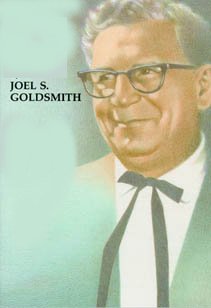
Joel Goldsmith


Joel Goldsmith is an enigmatic figure in the history of self-help. While never a real superstar of the movement, his books always had a cult following, and many of them remain in print to this day. His great classic was a slender book called The Infinite Way, which layed out his basic philosophy. Its brevity does not denote ease of reading, however, because it's a dense little volume. After its publication groups emerged all over the US and the world (up until the late 1990s there were still groups meeting here in Sydney) devoted to the study of the book and Goldsmith's philosophy.
He is often characterised as the great modern reformer of Christian Science, and he seemed to have attracted many followers from that camp. My favourite Christian Scientist, Doris Day, was a fan of Goldsmith's work, and claimed to go to sleep every night listening to his tapes.
Certainly Goldsmith's books present a more overtly religious - and by that I mean Christian - aspect than most of the other modern New Thought books. I suspect this is what stopped him from becoming a genuinely popular literary figure. The Jesus talk was simply too unpalatable for the general reader.
That said, once you begin to examine the books' underlying theology you quickly realise that we are not in the realm of mainstream Christianity here. Beside the fact that he was a great advocate of meditation, Goldsmith's own religious life was quite fascinating. he was born into an Orthodox Jewish family, and was educated in a Hebrew School. Quite when he began healing in the name of Jesus no-one knows, but Goldsmith described his emergence as a spiritual leader as a slow process, something that happened in stages until one day he realised that no-one came to see him any longer for business purposes - 100% of his days had been taken up by healing work. Taking this as a sign from God, he allowed his business to go broke and instead set himself up as a fulltime Christian Science practitioner. Later, of course, he was to reject the dogmas of that church, as so many had before him, and instead he established his own school based on similar principles, but allowing its students more intellectual and spiritual freedom.
Much of The Infinite Way seems to be pretty standard Christian Science minus the dogma and the insistence on exclusive truth. Goldsmith was at heart a Universalist, and recognised the name of Jesus as a concept and spiritual symbol more than a defining point of religious difference. He said that we need to develop an exclusively spiritual mindset, and once we did that the world will fall in line with the perfection that is the law of spirit.
To my mind Goldsmith's most readable book was Practising the Presence. Indeed, it is quite beautifully written, an extended meditation on the necessity to be always at prayer, always "showing forth the health, harmony, and wealth, which are our spiritual birthright..." (55).
There is a fascinating (and quite rare) biography written by one of his closest assistants which describes Goldsmith as a "Modern Mystic," and he certainly is entitled to that description.
As an example of mid-20th century self-help, The Infinite Way stands out as being among the most overtly religious in its vocabulary and concepts, but it was a religious view so unorthodox that it separates Goldsmith from those other great populist clergymen Norman Vincent Peale and Fulton J. Sheen.

Tuesday, January 20, 2009

The Power of Positive Thinking


While I was in Phnom Penh I was delighted by the presence of really quite good second-hand bookshops - something that is absent from Vietnam. As usual in such places, there was an eclectic collection of books - heavy on chick-lit and murder mysteries, and also a substantial number of business and self-help titles. For US$3 I bought this well-thumbed copy of the self-help classic The Power of Positive Thinking, and it travelled with me all through Cambodia and Vietnam.
I had never read it before, so was surprised to discover that it is extremely religious in content - Peale's main advice throughout the book is to read and memorise scripture and use quotes from the Gospels as positive affirmations. I can't imagine it appealing at all to modern day self-help readers, who are largely an unbelieving bunch, and those that are interested in spirituality tend to steer away from the old-fashioned style of 'memorise scripture' Christianity.
It would be unfair, however, to characterise Peale as some sort of fundamentalist Christian idealogue trying to propagate a religious agenda by stealth. He was, after all, an ordained minister, and a famous one at that. Kind of like the Benny Hinn of his time, only nicer and more substantial.
Peale had been born a Methodist, but became a famous clergyman with the Reform Church in America, which was very similar in theology and worldview. And while the religious advice he offers in this book is perfectly inoffensive and acceptable to almost any kind of Christian, his own personal beliefs were reasonably unconventional and progressive - influenced as they had been by the New Thought teachings of Charles Fillmore and Ernest Holmes, and incorporating a species of spiritualism influenced by his reading of Swedenborg.
So it's an odd book - I wouldn't even call it self-help, more a prayer manual and a practical guide to using the Bible. But if you find it in any bookshop (and it is still in print) it will almost certainly be filed under "Self-Help."