Tuesday, September 21, 2010

How To Win Friends and Influence People


For many (me included), How To Win Friends and Influence People is the archetypal self-help book. Whenever people ask me what I mean by self-help (and I am constantly surprised by how few people have a clear understanding of what a self-help book is) I mention this book and they understand instantly where I'm coming from.
The elements that make the book a quintessential example of the self-help genre include:

  1. It is filled with potted biographies telling of how people have changed their lives and succeeded
  2. The author is incredibly self-referential - many of the success stories stem from people who have won out in life through taking Dale Carnegie's own courses
  3. It promises something enormous and quite intangible - let's face it, 'influencing people' is a pretty grand and indefinable claim
  4. It attempts to cover many different aspects of life experience - work, marriage, conversation, friendship, social life - all are addressed by Mr. Carnegie, and solutions for improving them all are offered
First published in 1937, How To Win Friends... has been a perpetual bestseller almost ever since. There are various updated versions around, but these are almost more dated than the original, with their clumsy references to new-fangled things like VCRs. I prefer the good old fashioned original, complete with its occasional lapses into sexism and racism.
Carnegie was also one of the earliest examples of that peculiar self-help phenomenon - the person who becomes rich and famous through telling others how to get rich and famous. He had begun life in humble circumstances, and started his career as a self-improvement guru by teaching courses in public speaking at the YMCA.
Once his book had rocketed him to fame he established his own training institute, which still exists today, training businessmen in the quaint 1930s manners and courtesies which must be even rarer now than when Carnegie first started out.
Some have accused the book of being Machiavellian, encouraging people to manipulate others by cultivating reactions and responses intended to please and, ultimately, influence. Carnegie's methods have also been hailed as an early form of NLP, exhibiting a sophisticated understanding of human psychology - and frailty.
The most famous injunction form the book is to always be "hearty in your approbation and lavish in your praise." Carnegie contends that we gain more influence and regard by praising and encouraging than criticising and fault-finding. But he always stresses that any such praise should be based in genuine feeling, because "Flattery is counterfeit, and like counterfeit money, it will eventually get you into trouble if you try to pass it on."
And from all the accusations of cynical manipulation of the feelings of others, I feel I must defend Carnegie. What he is really encouraging is that we should all take a genuine interest in the stories and ideas of others. He is talking about the cultivation of a more open mind, and championing the art of interested listening. Yes, he says that such an interest in others will bring with it social rewards, but it may also bring about an improvement in character and learning in the practitioner.
In many ways it is a more conversational, and more detailed, examination of the hierarchical structures in which we all live, the systems of power that had been mapped out more conventionally (and less interestingly) in the etiquette books of the 19th century. Carnegie, a smart man of humble birth, had worked out that a species of power lay in acknowledging and feeding the power fantasies of others. Indeed, the whole book could be read as a Foucauldian exercise in rallying opower to the cause of one's own social advancement.
Carnegie was a gifted and charming writer, and even now the book is a very easy read, filled with nuggets of folk wisdom and constant references to the life lessons to be gleaned from notable figures in history.
15 million people have read How To Win Friends.. since its release, and it is almost certainly the most influential self-help book ever published.

Wednesday, September 15, 2010

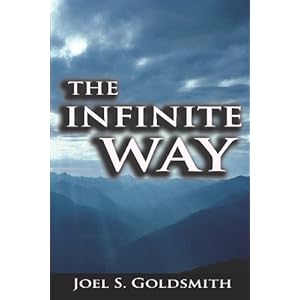
The Infinite Way


The Infinite Way is one of the great classics of self-help literature - indeed, it is one of the books on the 'Timeline of Self-Help Writing' that I put together for my thesis.
Based largely on the teachings of Christian Science, it is a slender book, quite poetic in its content and deeply mystical. Though not a formal exponent of Christian Science, Joel Goldsmith was influential in Christian Science circles. His works were great favourites of Doris Day, who said she went to bed every evening listening to audio recordings of Goldsmith's lectures. But in rejecting the formal affiliation with the church, Goldsmith places this, his most famous and enduring work, in the canon of New Thought, and it's is still read and enthusiastically recommended by serious students of New Thought.
Though short, it is reasonably dense, and is really meant to be read slowly and reflectively. Indeed, since its publication groups have sprung up devoted to the reading and study of the book, establishing around Goldsmith a quasi-religious structure. Such groups were active in Sydney well into the 1990s, though I'm not aware that there are any still going.
The central message of the book is the basic Christian Science doctrine that we are merely expressions of God, and therefore perfect. Goldsmith tells us that God's reality is all-good, and so the only truth is in abundance, health, happiness and prosperity. The only truth is God, expressed in many different ways. "God, Consciousness is forever expressing Itself and Its qualities. Consciousness, Life, Spirit, can never fail. Our task is to learn to relax and let our Soul express itself" (38).
The book is really an extended meditation in that same style - there is little that is practical here, for Goldsmith returns again and again to his central theme: we need only awaken to God, who is already in us. It is a devotional text rather than an instructive text. And as such it frequently transports the reader with great gusts of hope, and with a carefully constructed mystical longing. This is Goldsmith's power as a writer - he can make his particular philosophy, singular as it may be, distinctly beguiling.
"We must begin our days with the inner reminder of our true identity. We must identify ourselves as Spirit, as Principle, as the law of Life unto our affairs. It is a very necessary thing to remember that we have no needs: We are infinite, individual, spiritual consciousness embodying within ourselves the infinity of good..." (80). The Infinite Way (Goldsmith's first book), then, serves as a textual way to remind us of this heavenly identity. There is much of Swedenborg in this, as of course there is in the work of Mary Baker Eddy.
There is some discussion of healing in the book, and it seemed as though healing was a central part of Goldsmith's lectures, but he tends not to be too specific in The Infinite Way. The book takes an extreme position: there is no illness, and all healing is but the return to the promised spiritual state of perfection.
Goldsmith was a prolific author, and many of his books remain in print. The Infinite Way remains his greatest achievement, however, and is an absolutely intriguing exercise in New Thought absolutism.

Tuesday, September 7, 2010

Ask Yourself This - Wendy Craig-Purcell


Ond of the podcasts I listen to religiously is Unity FM's Hooked on Classics. It is a weekly book club that examines books by and about the Unity Church and New Thought. From the point of view of my thesis writing it is a valuable process, because it really examines New Thought ideas in depth, and from a number of different perspectives. On a personal level, I enjoy the whole process of reading a book very closely over a couple of months and hearing it analysed week-by-week. I've always wanted to be in a book group, but my insane schedule doesn't allow for it. This is the perfect compromise.

One of the books recently studied was Wendy Craig-Purcell's Ask Yourself This. Craig-Purcell is a Unity Minister, and spoke about her own book on several of the shows. Needless to say I found this a prticularly fascinating exercise, a kind of anti-Barthesian commentary that actually says a lot about self-help writing and it's excessive intertextuality and self-referencing.

The premise of the book is that it represents a series of personal questions that the reader should ask herself. These questions are challenging and are meant, naturally, to facilitate personal and spiritual growth. As well as exploring the questions at length in print, the reader is also asked to meditate on each question and to journal on the reflections, thereby deepening the impact of the reading process.

The questions are not particuarly innovative or unusual, but they are broad enough to be quite challenging to answer, and spending time in wondering about them causes any number of additional questions to be formed in the mind of the engaged reader. Questions include such things as:

"What am I looking for?
Who am I trying to change?
If I knew I would be successful, what would I be saying "yes" to?"


The final chapter of the book is a peculiar diversion into the area of home schooling, something about which the author is passionate. Home schooling is a hot topic in America, and Craig-Purcell is keen to explore it as a religious person who is neither conservative nor fundamentalist. I must say that this section seems to sit awkwardly with the rest of the book, however, and for this reader at least added nothing to the process being explored. And certainly in Australia, where home schooling is a non-issue, this whole bit can profitably be ignored, and the book be wound up at the end of chapter 7.

Ask Yourself This is interesting because it is not a practical self-help book. Published by Unity House, the Unity School of Christianity's own publishing arm, the book is decidedly spiritual in bent, and the questions are intended to inspire prayer and reflection rather than specific action. This leaves the whole process of reading the book and folllowing its suggestions a much more open-ended process, and one I think would be quite attractive to many readers, particularly if they are of a more mystical bent.

I enjoyed the book, and interestingly I read most of it while I was on retreat at a Benedictine monastery, and it was the perfect companion on such an occasion. Slim and easy-to-read, Ask Yourself This is an excellent primer in New Thought and a nifty text for helping the reader to explore some of the more challenging (and more grandly focused) spiritual niches of the mind.

Tuesday, August 31, 2010

Emma Curtis Hopkins


Probably the most famous obscurity in the history of self-help literature, Emma Curtis Hopkins (1849-1925) is known as "the teacher of teachers" and was responsible for the training of many of the stellar figures in the New Thought movement.

A quiet, reclusive wopman, Hopkins had for a time been Mary Baker Eddy's right-hand woman. Eddy banished her, however, when Hopkins made it clear that she would not become a mindless devotee. Never one to brook opposition, Mrs. Eddy became furious when she learned that Hopkins was devising some of her own ideas, and so caused the division which would help shape a whole new movement (New Thought) and probably, ulitimately, guaranteed the eventual obscurity and decline of Christian Science.

While she always propagated the general ideas of Christian Science, Emma Curtis Hopkins was much more committed to ideas of personal choice and individual free will, and lacked Eddy's famously dogmatic personality. Travelling from city to city, Hopkins would set up shop in a genteel hotel and set about teaching lessons in 'Christian Healing' to select groups of students. In this quiet way she lived out her life, earning a living from teaching her lessons and spending much of her time alone and in prayer.

Painfully shy, Hopkins (who had left her husband years ago in order to follow Mary Baker Eddy) spent most of her time her room, occasionally releasing a book. These books were extraordinarily dense and difficult to read (inspired, most probably, by the style of her great mentor), but their subject matter continues to influence the content and ideas of self-help, though most authors are completely unaware of it. Though gentle and retiring, she must have been possessed of a great charisma, because she taught and inspired people like Charles & Myrtle Fillmore, Nona Brooks and, right at the end of her life, Ernest Holmes.

Her own books are really exercises in theology, and barely fit the mould of self-help at all. They explore biblical stories and the sayings of Jesus in-depth, in a manner obviously inspired by Eddy. Because of the radical nature of her views and the popular manner of their propagation, she is yet to be recognised as a theologian, though I would suggest she is, perhaps one of the greatest and most influential biblical scholars of the late 19th and early 20th centuries. Her continued obscurity is testament to the shameful gap in knowledge about New Thought and its importance on the behalf of most historians and scholars of religion. This obscurity was, however, addressed brilliantly by Gail M. Harley in her scholarly 2002 biography of "The Forgotten Founder of New Thought."

Hopkins was as well a committed 'womanist', a proto-feminist whose inspiration and ideas helped shape the New Thought movement into the female-dominated domain it was and is.

Norman Vincent Peale


One of the giants of self-help writing is Norman Vincent Peale. He almost single-handedly defined the genre in the 1950s and 60s, starting off with his monumental bestseller The Power of Positive Thinking, and he established for decades a particular style of self-help writing, a style which is still being emulated today.

I have written before of the overt religiosity of Peale's writing, and his radical re-casting of Christianity as a positive aid to lifestyle and success both captured the zeitgeist of mid-20th century America and helped, in part, to shape it. The stolid Protestant friendliness of Peale's utterances, coupled as they were with just the right degree of acknowledgement of science and medicine, set the minds of a generation at ease. His great genius of expression inspired other writers, most notably the Catholic Bishop Fulton J. Sheen, who sought to do with Catholicism what Peale had done with mainline Protestantism. In Australia Peale's style was copied by the Presbyterian clergyman Gordon Powell.

Peale sought to reconcile Christianity with psychiatry, something M. Scott Peck managed so successfully a generation later with The Road Less Travelled. Peale established the American Foundation of Religion and Psychiatry right next door to his church, and from here he attempted a kind of Christian psychotherapy, employing professionals from both camps. It would seem that counselling was his great passion, and his books are filled with case studies of people he had counselled. He seemed inordinately proud of the new hybrid he had created. Of course, this movement seems these days to have come to nothing and at the very most Christian-tinged counselling and psychology has acquired a dubious name, associated as it has become with the extreme right-wing fringe of Christianity, and the mental and spiritual abuse of young women and gay people.

Peale, I think, would have been shocked by the state of things now. He was most certainly not a fundamentalist, and saw himself as a part of the great tradition of American liberal Protestantism. Though the language of his books is almost shocking to a contemporary secular audience, it's worth keeping in mind that his reading of the Bible and his theological understanding was distinctly progressive. Though he claimed all his life to be a conventional Protestant clergyman, and was lionised by people like Billy Graham and Ronald Reagan, he was deeply influenced by the ideas of New Thought, and was for a time a student of Ernest Holmes.
Like most successful self-help writers, he diversified into other forms of media, and was particularly successful on radio, where his program 'The Art of Living' ran for 54 years. He was also one of the first to produce audio versions of his books, and you can still buy recordings of him reading The Power of Positive Thinking.

These days Peale is deeply unfashionable, though his books remain in print. It is hard to imagine that his worldview, as unashamedly religious as it was, will ever again be mainstream. Self-help critic Wendy Kaminer, in her book I'm Dysfunctional, You're Dysfunctional, accuses Peale of being a magical thinker and "oblivious to social injustice."


Wednesday, August 25, 2010

The Law of Attraction


Probably one of the most vilified tenets of self-help philosophy is the concept of The Law of Attraction. This "Law" has achieved a significant amount of cultural currency in recent years due to The Secret - basically, the Law of Attraction WAS The Secret (sorry if that's a bit of a plot spoiler!), and many millions of people encountered the idea for the first time there.
But it is a mistake to think it is a recent invention. Rhonda Byrne herself freely admits that she came across the idea of LOA while reading the works of Wallace Wattles, books published around the turn of the 20th century. The idea in its recognisable form can probably be dated back to Charles and Myrtle Fillmore and the Unity School of Christianity in the closing decades of the nineteenth century.
What is the Law of Attraction? Simply put, it is the idea that whatever you think about, you attract. As the Buddha used to say in the opening credits of Monkey, "With our thoughts, we create the world."
This idea goes well beyond the pioneers of New Thought, of course. This kind of "mind only" philosophy has a long history in Buddhism and, before that, Advaita Vedanta schools of Hinduism. I think the real difference between these Eastern and Western forms is where the emphasis lies. For the most part, this realisation in Hinduism and Buddhism is meant to lead the seeker to try and transcend this world, realising that ultimately nothing is real, and all is meaningless, a creation of our desire. Law of Attraction as it has manifested in popular American thought has been directed in a thoroughly more worldly manner: since we're creating our world, how about we create a really nice one.
Nothing wrong with that, of course. Indeed, many of the spiritual practices of Mahayana Buddhism involve just this process, visualising the jewelled Buddha lands and the extraordinary treasures of various divine realms. The Law of Attraction enthusiasts are, if anything, a shade more honest than most of their consumerist counterparts, by recognising that they want nice things in their world, and seeking to create these things at a metaphysical level. Whether or not you believe this is possible is a whole other question, and one in which I do not engage.
What I do find interesting is the vehemence with which such beliefs are denounced by those who don't share them. As religious beliefs go, I consider the Law of Attraction a pretty benign one. It certainly beats a whole lot of other worldviews, including those of most who pour such scorn on the LOA scene.
At its simplest I really just see LOA as a Western re-casting of the same ideas of karma and rebirth that are subscribed to by pretty much most of the Hindu and Buddhist world. As such, it attracts many of the same criticisms and is subject to all the same shaky logical and philosophical premises. It's just that, being an idea seen (incorrectly) as the product of modern consumer culture, it is subjected to the kind of paternalistic scorn that people would never dare direct toward a Hindu or a Buddhist.
The fact that it is always described as a "Law" is also significant. The new religious movements that emerged in America at the end of the 19th and beginning of the 20th centuries were all, to some extent, responding to modernity. One of the ways they did that was by casting their new ideas not as religious revelations, but as much more scientific-sounding "Laws", "Principles" and "Sciences."
Apart from The Secret, the great proponents these days of the Law of Attraction are a cuddly pair of middle-American trance channelers called Esther and Jerry Hicks. Esther channels the voice of a disembodied entity called "Abraham" and this material sells wildly throughout the world, making the Law of Attraction more and more one of the strongest contemporary popular religious beliefs.

Tuesday, August 3, 2010

Yes You Can! - Behind the hype and hustle of the motivation biz


From where I sit here in Australia, one of the most esoteric and quintessentialy American occupations must be that of professional speaker. It almost seems unbelievable that someone can earn their living from talking to rooms full of people. It seems to hark back to an earlier age, to the times when Dickens, Wilde and Twain travelled the US lecturing to vast audiences.
In Yes You Can! ex-Playboy editor Jonathan Black examines this amazing industry, and is drawn into its high-energy milieu to the point of seeking to become a motivational speaker himself.
Refreshingly, he never sets out to "expose" the industry, or to tear it apart. As he points out, he simply never met anyone who was manipulative, hypocritical or unusually avaricious. The motivational speaking industry is like any other, and Black does a brilliant job in explaining just how mundane - and often corny - its particular machinations are.
The speakers, both obscure and struggling and stellarly successful and wealthy, are shown here to be a wonderful crowd of eccentrics, each constantly working an angle and trying to stand out in a monstrously competitive field. His descriptions of their schtick are somethimes hilarious, and Black retains a cynic's eye throughout. But along with him you can't help but admire the incredible drive of these people to be successful.
Conceding that it is the type of career that normally attracts a bad rap, he speaks about the efforts being made to quantify the impacts of motivational speakers on company morale and - ultimately - profit. Unsurprisingly, this still looks like being almost impossible.
I was conscious throughout of the ways in which the self-help industry employ a wide range of media and technology to spread its message and, of course, to make money. The presence of so many celebrity speakers reminds us that this whole philosophy was born on the pulpit something which Black himself ultimately realises, in a moment of great personal significance. The speakers promote their audio material and their books, and vice versa, ad infinitum. This multiplicity of media marks motivation and self-help as distinctly modern phenomena, born in the age of modernity and in reaction to the changes it forced upon society.
Yes You Can! is a great book - well written, well researched and sensitively rendered. Jonathan Black has approached the subject in a uniquely thoughtful way and offers, for a change, some genuine insight into the business of self-help, instead of the usual blanket condemnation.